
In partnership with patient advocacy groups and industrial collaborators, we have pledged to help democratize access to physiologically relevant human models of neurodegenerative disease. The Early Access axoCells™ derived from patient-derived iPSCs are widely available to the global scientific community.
axoCells™ human iPSC-derived cortical neuron cells, media, supplements and coating kit, unaffected male donor (ax0004), ≥1.5 million cells

Features
- Derived from human iPSCs, from a male donor, aged 40-50, unaffected
- Express the typical markers of neural stem cells (PAX6, FOXG1, SOX1, TUJ1 and Nestin)
- Human iPSC-derived cortical neuron cells, media, supplements and coating kit
- TempO-Seq™ data available on request
Specifications
Number of cells: ≥1.5 million
Donor: male, aged 40-50
Genetics: healthy donor

Price:
£1,800.00

Description
These iPSC-derived neural stem cells (NSCs) from a healthy donor provide a physiologically relevant human control for neurodegenerative disease modeling and drug discovery. Derived from an unaffected male donor aged 40–50 with normal HTT CAG18/CAG39 and ApoE2/E3 genotypes, these cells are an appropriate control for Huntington’s disease (HD) (ax0219) and Alzheimer’s disease (AD) iPSC-derived disease models.
-
Control for HD/AD research: normal HTT (CAG18/CAG39) and ApoE2/E3 genotypes for genotype-matched studies
-
Maturation potential: can be efficiently matured into cortical excitatory neurons (MAP2, TBR1, CTIP2, VGLUT, TUJ1) with optimized media and supplements provided in this kit
-
Isogenic CNS panel: matches microglia (ax0664), astrocytes (ax0704), motor neurons (ax0076), and interneurons (ax0662) for integrated multi-cell studies
User Guides
Early Access products are derived from patient or unaffected donor iPSC lines. These individual lines may exhibit different characteristics in culture due to the unique genetic background and disease risk factors. Our User Guides provide detailed protocols, however we recommend using standard optimization techniques and monitoring cells carefully to take into account the disease phenotype and intrinsic differences in iPSC-derived cells.
If you would like to discuss the protocols, disease models, or suitable endpoint assays in more detail, please reach out to our scientific team.

The ax0004 neural stem cells provide a critical baseline for Huntington’s disease and Alzheimer’s disease research because they represent an unaffected donor with a normal HTT genotype (CAG18/CAG39) and an ApoE2/E3 genotype. This makes ax0004 an ideal control for comparing disease-specific phenotypes observed in HD models such as ax0219 and for studying ApoE-related mechanisms in AD. Data from ax0004 enables researchers to distinguish pathological changes, such as CAG repeat instability, altered morphology, hyperexcitability, and ApoE-driven effects, from normal neuronal behavior. By serving as a genetically stable reference, ax0004 ensures accurate interpretation of functional endpoints like neurite outgrowth, spontaneous firing, and mitochondrial health, which are essential for validating therapeutic targets and assessing drug efficacy.
Phenotypic characterization: morphology
iPSC-derived striatal neurons derived from an unaffected donor (ax0004) cluster after day 25, showing large cell clusters by day 30, while HD striatal neurons (ax0219) derived from CENSOi019-B remain very neuronal throughout the maturation period. These phenotypic differences have been observed repeatedly in these lines.

Phenotypic characterization: immunocytochemistry
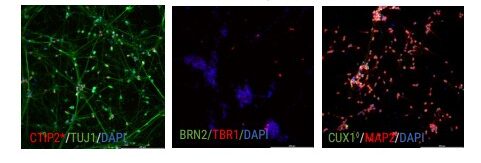
Control striatal neurons (ax0004) express CTIP2, DARPP32 and GABA, markers indicative of mature striatal neurons in addition to neuronal markers like TUJ1 and MAP2.

Immunocytochemistry demonstrating the expression of key cortical neuronal markers.
Striatal neurons derived from the CENSOi019-B line (ax0219) longitudinal studies
ax0219 (CENSOi019-B) and ax0004 (Control) were matured to striatal neurons and cultured for 100 days (the control line did not survive beyond 60 days). Samples were taken throughout the maturation process to assess CAG expansion.

Morphology and neurite outgrowth: CENSOi019-B HD line vs unaffected donor
Morphology of HD striatal neurons and control striatal neurons at Day 20 recorded on IncuCyte®. The controls form many more large clusters and this becomes more prominent as they mature over time which is why it becomes more inaccurate as shown on the graphs.

characterization of the hyperexcitability phenotype in iPSC striatal neurons
Representative sodium spike traces from one electrode of control striatal neurons and HD striatal neurons from the HD line at Day 25 of differentiation show a trend toward increased activity in the HD line.
The HD line displays more frequent spikes, indicating greater neuronal activity. Since striatal neurons are inhibitory by nature, minimal activity is expected in neurons from unaffected donor backgrounds.
The HD line shows activity across most electrodes, whereas the control line exhibits activity in only one electrode, further supporting a trend toward hyperexcitability in the HD model.

Applications
Our axoCellsTM striatal neuron progenitors are suitable for investigating Huntington’s disease and for screening candidate therapies for this disease.
Healthy control lines are also available and can be used with high–content imaging, MEA, microfluidic and organ-on-chip (OOC) devices to measure structural and functional responses in neuronal models.
Quality
We maintain or exceed industry-level quality with our ISO:9001-accredited production facility, guided by our rigorous quality control procedures and decades of scientific experience.
All cells come with a full Certificate of Analysis and are officially certified by HPSCreg®, to ensure ethical and biological conformity for your peace of mind.
Licenses & Consent
Axol has obtained all relevant licenses for reprogramming donor samples into iPSCs and differentiating these into striatal neurons for commercial use.
Patient samples used to create these neurons have been ethically sourced and consented for research and commercial use. All cells come with a full Certificate of Analysis and are officially certified by HPSCreg®, to ensure ethical and biological conformity for your peace of mind.
Publications
Glaser, T., Shimojo, H., Ribeiro, D.E. et al. ATP and spontaneous calcium oscillations control neural stem cell fate determination in Huntington’s disease: a novel approach for cell clock research. Mol Psychiatry 26, 2633–2650 (2021). https://doi.org/10.1038/s41380-020-0717-5
Mathkar, Pranav P. et al. ‘Characterization of Neurodevelopmental Abnormalities in iPSC-Derived Striatal Cultures from Patients with Huntington’s Disease’. Journal of Huntington’s Disease, vol. 8, no. 3, pp. 257-269, 20191 Jan. 2019 : 257 – 269. DOI: 10.3233/JHD-180333
Media and Reagents
Using our kit of specially formulated striatal neuron media ax0333, growth factors BDNF ax139800 and GDNF ax139855, and SureBond–XF coating, mature striatal neurons can be generated in 31 days. We also supply all reagents as standalone items.


