
>>> READY TO SHIP PRODUCT
axoCells™ human CNTF supplement, 20 µg

axoCells™ human CNTF supplement, 20 µg is a recombinant growth supplement necessary for promoting the maturation of sensory neurons, motor neurons, basal forebrain neurons and type 2 astrocytes for pain, sensation and neuroscience research. Suitable for use with axoCells Sensory Neurons.
• Promotes the maturation of sensory neurons, motor neurons, cortical neurons and astrocytes for pain, sensation and neuroscience research.
Specifications
Volume 20µg
Shipping conditions Ambient temperature
Storage conditions See CoA shipped with product
Description
axoCells™ human CNTF supplement, 20 µg is a recombinant growth supplement necessary for promoting the maturation of sensory neurons, motor neurons, basal forebrain neurons and type 2 astrocytes for pain, sensation and neuroscience research. Suitable for use with axoCells Sensory Neurons (ax0555, ax0055).
Top Resources
Additional Information
Phase contrast
Phase contrast images show the differentiation and maturation of axoCells Sensory Neuron Progenitors over two weeks after thawing and treatment with mitomycin C.
Phase contrast images of axoCells Sensory Neuron Progenitors The cells were plated on SureBond-XF in Neural Plating Medium. The cells were then treated with mitomycin C two days after thawing and cultured in the supplemented Sensory Neuron Maintenance Medium. (axoCells sensory neurons should be cultured for a minimum of 3 weeks prior to performing endpoint assays.)

Immunocytochemistry
Immunocytochemistry (ICC) images of axoCells sensory neurons show expression of the key marker TUJ-1, indicative of neuronal development, and the nociceptive ion channels TrpV1, Nav1.7 and Nav1.8, responsible for the generation and maintenance of abnormal neuronal electrogenesis and hyperexcitability in the development of pathological pain.
ICC of axoCells Sensory Neuron Progenitors The cells were plated on SureBond-XF in Neural Plating Medium. The cells were then treated with mitomycin C two days after thawing and cultured in the supplemented Sensory Neuron Maintenance Medium. (axoCells sensory neurons should be cultured for a minimum of 3 weeks prior to performing endpoint assays.)
Culturing axoCells sensory neurons with Maximizer supplement speeds up maturation. On average we see increases of 30-45% of neurons expressing TRPv1 and Nav1.7 upon treatment with Maximizer.

Sodium ion channel expression
Sodium channel RNA expression analysis by cDNA PCR
axoCells Sensory Neuron Progenitors show RNA expression of all three voltage-gated sodium ion channels, Nav1.7, Nav1.8 and Nav1.9.
cDNA from axoCells Sensory Neurons was compared to cDNA from human tissue from the dorsal root ganglion (DRG). PCR analysis (40 cycles; 55oC ) confirmed the mRNA expression of SCN9A (82 bp, hNav1.7), SCN10A (149 bp, hNav1.8) and SCN11A (464 bp, hNav1.9) in axoCells sensory neurons. SCN5a (237 bp, hNav1.5) was included as a negative control. Data provided by Dr Edward Emery (University College London).

Capsaicin and menthol responses
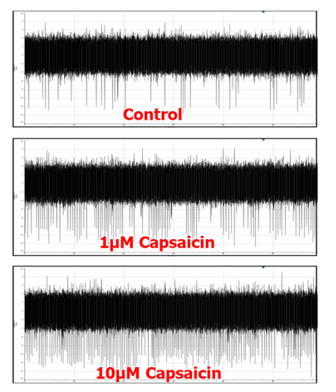
axoCells sensory neurons were challenged with capsaicin and menthol at 22 and 27 days respectively. As early as 22 days, 90% of the neurons responded to capsaicin challenge with increased spike measurements on a multi electrode array (MEA) platform.
Initial menthol application caused an increase in spike firing, demonstrating appropriate functional activity of the sensory neurons, but repeated application was seen to trigger a decrease in spike firing or tachyphylaxis (i.e. desensitization).
Dose responses for both chemicals were observed, demonstrating how the axoCells sensory neurons could be used as advanced in vitro models of pain, sensation, and peripheral nervous system disorders for drug discovery and cosmetic toxicity testing.
TTX-resistant Nav1.8 and Nav1.9
Nociceptive sensory neurons are unique in that they contain voltage-gated inward current sodium channels (Nav 1.8 and Nav 1.9) that are resistant to tetrodotoxin (TTX). The presence of these TTX-resistant ion channels was confirmed in axoCells sensory neurons.
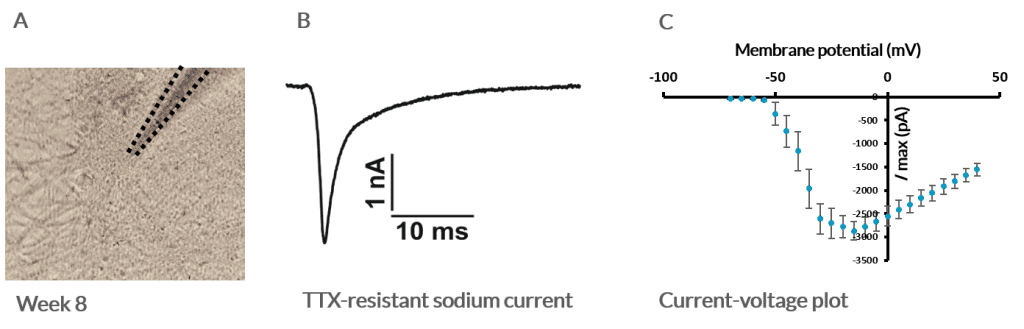
Electrophysiological characterization of axoCells sensory neurons using patch clamp. A) Phase contrast image of axoCells sensory neurons; B) Example of a sodium-current elicited by a voltage step from -100 mV to -25 mV in the presence of tetrodotoxin (0.5 mM); C) Current-voltage plot of averaged Na-currents recorded from iPSC-derived sensory neurons in the presence of TTX (n=9). Data provided by Dr Edward Emery (University College London).
Mustard Oil and ATP treatment
Mustard Oil treatment of axoCells sensory neurons elicited a significant increase in the number of spikes on MEA, indicating the contribution this agent plays to the pain response. Mustard oil is an agonist of the TRPA1 (transient receptor potential ankyrin 1) receptor.

ATP treatment of axoCells sensory neurons also elicited a significant increase in the number of spikes on MEA. ATP opens ligand-gated ion channels (P2X receptors) in sensory neurons.

Thermoception
A change in the firing pattern of axoCells sensory neurons was seen in response to temperature change. Increased firing on MEA was seen in axoCells sensory neurons in response to heating and decreased firing in response to cooling. This demonstrates thermoception, an in vivo function, and shows axoCells sensory neurons to be functionally relevant cells.

Paclitaxel
Treatment of axoCells sensory neurons with the chemotherapy reagent paclitaxel demonstrates reduced neurite length (axotomy) and the functional relevance of the sensory neurons. This provides a model for both acute insult and chronic cytotoxicity.

Response of axoCells sensory neurons to paclitaxel, a chemotherapy reagent, applied at double arrow (washoff at single arow).
Applications
Our axoCellsTM sensory neurons have been specifically developed for use in microfluidics systems, organ-on-chip devices and for in vitro disease modelling.
We have a community of top ten biopharma and research institutes who use our sensory neurons to build powerful in vitro models, investigating disorders of the peripheral nervous system, chronic pain and analgesic drug screening.
Protocols
We offer a fully optimized cell culture system including tailored Sensory Maintenance Medium to promote the viability and maturation of sensory neurons for endpoint assays on glass or plastic.

Quality
We maintain or exceed industry-level quality with our ISO:9001-accredited production facility, guided by our rigorous quality control procedures and decades of scientific experience.
All cells come with a full Certificate of Analysis and are officially certified by HPSCreg®, to ensure ethical and biological conformity for your peace of mind.
Licenses & Consent
Axol has obtained all relevant licenses for reprogramming donor samples into iPSCs and differentiating these into sensory neurons for commercial use.
Patient samples used to create these neurons have been ethically sourced and consented for research and commercial use. All cells come with a full Certificate of Analysis and are officially certified by HPSCreg®, to ensure ethical and biological conformity for your peace of mind.
Publications
The RNA-Binding Protein HuR Is Integral to the Function of Nociceptors in Mice and Humans- Kunder N,et al. 2022. J Neurosci. doi: 10.1523/JNEUROSCI.1630-22.2022. Epub 2022 Oct 21. PMID: 36270801; PMCID: PMC9761683.
Macrophage epigenetic memories of early life injury drive neonatal nociceptive priming- Dourson AJ et al. bioRxiv [Preprint]. doi: 10.1101/2023.02.13.528015.
SARS-CoV-2 papain-like protease activates nociceptors to drive sneeze and pain.- Mali et al 2024. bioRxiv [Preprint]. 2024 doi: 10.1101/2024.01.10.575114.
Emerging Neurotechnology for Antinoceptive Mechanisms and Therapeutics Discovery – Black et al 2018 Biosensors and Bioelectronic https://doi.org/10.1016/j.bios.2018.11.015
A Microfluidic Approach to Investigate Changes in Functional Properties of Nociceptive Axons Underlying Inflammatory Pain States – Natasha Rangwani 2018. PhD Thesis
Human stem cell derived sensory neurons are positioned to support varicella zoster virus latency – Sadaoka et al. 2020 BioRxiv https://doi.org/10.1101/2020.01.24.919290
Varicella-zoster virus VLT-ORF63 fusion transcript induces broad viral gene expression during reactivation from neuronal latency – Ouwendijk et al. 2020 Nature Communications https://doi.org/10.1038/s41467-020-20031-4
Mechanistic insights into the pathogenesis of microtubule-targeting agent-induced peripheral neuropathy from pharmacogenetic and functional studies – Chua et al. 2021 BCPT https://doi.org/10.1111/bcpt.13654
Considerations for a Reliable In Vitro Model of Chemotherapy-Induced Peripheral Neuropathy – Eldridge et al. 2021 Toxics https://doi.org/10.3390/toxics9110300
In Vitro Pain Assay Using Human iPSC-Derived Sensory Neurons and Microelectrode Array – Odawara et al. 2022 Toxicological Sciences https://doi.org/10.1093/toxsci/kfac045
Global analyses of mRNA expression in human sensory neurons reveals eIF5A as a conserved target for inflammatory pain – Chase et al. 2022 FASEB J. https://doi.org/10.1096%2Ffj.202101933RR
Use of a human induced pluripotent stem cell-derived dorsal root ganglion neurone model to study analgesics in vitro: proof of principle using lidocaine – Smulders et al. 2022 British Journal of Anaesthesia https://doi.org/10.1016/j.bja.2022.09.009
Chow SYA, et al. 2022. Human sensory neurons modulate melanocytes through secretion of RGMB. Cell Rep. 2022 Sep 20;40(12):111366. doi: 10.1016/j.celrep.2022.111366. PMID: 36130522.
Novel artificial nerve transplantation of human iPSC-derived neurite bundles enhanced nerve regeneration after peripheral nerve injury – Nishijima et al. 2023 Research Square https://doi.org/10.21203/rs.3.rs-3503996/v1
Scalable generation of sensory neurons from human pluripotent stem cells – Deng et al. 2023 Stem Cell Reports https://doi.org/10.1016/j.stemcr.2023.03.006
New human in vitro co-culture model of keratinocytes and sensory neurons like cells releasing substance P with an evaluation of the expression of ZIKV entry receptors: A potent opportunity to test Zika virus entry and to study Zika virus’ infection in neurons? – Bocciarelli et al. 2023 Experimental Dermatology https://doi.org/10.1111/exd.14870
Deng T, et al. 2023. Scalable generation of sensory neurons from human pluripotent stem cells. Stem Cell Reports. 2023 Apr 11;18(4):1030-1047. doi: 10.1016/j.stemcr.2023.03.006. PMCID: PMC10147831.
Media & Reagents
Ensure high-quality, mature sensory neurons in just 21 days with our fully optimized media Sensory Neuron Maximizer kit (ax0158) and Maturation Maximizer media supplement (ax0058). We also supply cells, all growth factors and coating materials as a kit Human iPSC-Derived Sensory Neuron Maximizer Kit (ax0157) with cells).


